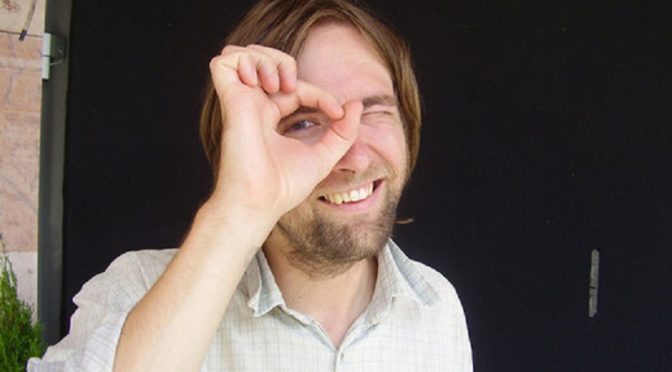
So who is Gyula Nemes?

A simple Google search reveals a daring director who has had a good share of industry awards and critics’ attention. But that’s not the whole story about Gyula Nemes.

A few films into his career, and Nemes is positioning himself as a rebel child of Hungarian cinema. In terms of his films, but also in terms of his views and statements.

He is no stranger to choosing hot issues to focus on. His short film The Lost World (was awarded at Karlovy Vart, Hamburg and Navarra) is a documentary about people living in houseboats and wooden houses, in danger of being evicted by investors. Nemes shot the 20 minutes doco over 10 years.

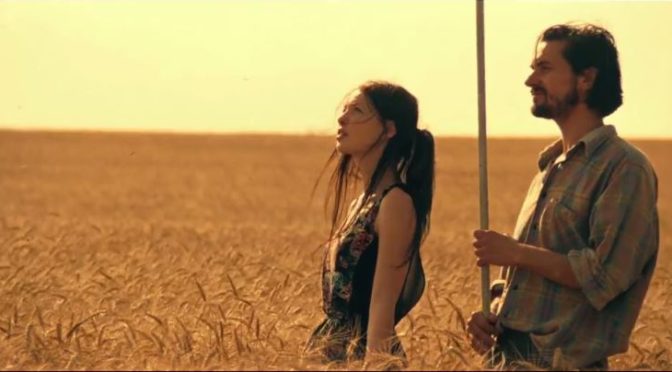
His latest film, Zero, released in 2015, imagines a near future where the imminent extinction of bees brings havoc among humans. It is an explosive experimental film, with a clear political agenda. As such, some scenes offended one of the funding bodies, the Hungarian Film Fund. Nemes had to concede to deleting them, but not without making it all public.

The incident, he confessed in an interview with the Hollywood Reporter, paired with recent political developments, are making him reconsider his future as a filmmaker in Hungary.

‘I don’t want to live in a country where there is an Iron Curtain. I want to live in a free country,’ said Nemes to the Hollywood Reporter interviewer.

But you can hear straight from the horse’s mouth this Sunday when we’re screening his latest film Zero.  As the time different didn’t allow for a live interview, Sabi Paisa is preparing a Skype interview with Gyula Nemes which we will play for you.

So book your tickets for Zero through Sustainable Living Festival now, or buy a EuRaw Stories pass.
The end starts with the bees

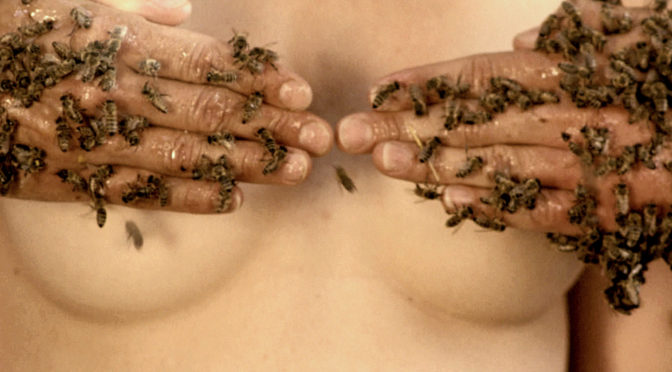
“Where there are no bees on the Earth, the humanity has a mere four years left to live’, said Albert Einstein. Einstein’s quote inspired director Gyula Nemes to explore this possibility.

Zero, his second fiction feature, starts from this premise and explores the interdependency between bees and humanity using a variety of cinematic genres: melodrama, burlesque, comedy. The story is accompanied by the buzzing of bees and the sound of TV commentaries, and there is no filmed dialogue.

But the lack of dialogue is compensated with a rich plot. The story revolves around the manager of an artificial honey factory who gets to taste real honey, and as a result decides to quit his job, move to the forest and become a beekeeper. But his bees start dying radiated by a nearby mobile phone mast. Together with his lover he launches an attack on everything that kills the bees: GM farming, factories, motorways. They become notorious celebrities and their fight triggers a revolution.

Unless you’ve been living under a rock, you would have heard about the collapse of bees colonies worldwide. Zero takes Einstein’s foresight and the current bees situation and runs with them in a playful daring cinematic display. So book your tickets through Sustainable Living Festival now, or buy a EuRaw Stories pass.

Not like other eco-films you’ve seen

The environmental message in Zero, Gyula Nemes’ second feature film, is very strong. But this is where similarities with other films in the genre end. You wouldn’t be wrong to depict Zero as a playground for Nemes’ whimsy.

In only 83 minutes, the film explores several genres, from comedy, environmental parody, melodrama, road movie, and even burlesque. You can see how it might be a bit difficult to categorise it.

Beyond genre experimentation, Nemes pushes the boundaries with his political commentary. Zero risked being banned in Hungary and losing funding from the Hungarian National Film Fund unless a controversial scene was removed. Which Nemes did, but also told his audiences all about it. The offending scene featured a character firing a shot at portraits of leading politicians painted on watermelons, one of them particularly in disagreement with the fund. And the show goes on…

“This is a very subversive film about globalization, capitalism, political dictatorship and pollution,” a jesting Nemes told Hollywood Reporter. “We had very long discussions with the film fund about which fruit we can [use]…watermelons, apples…and which politicians we can shoot into the face and which not.”

If this sparked your interest a little bit, book your tickets for Zero through Sustainable Living Festival now, or buy a EuRaw Stories pass and you’re in.


What do sustainability and EuRaw Stories have in common?

In February Melbourne will be buzzing with environmentally-themed events, the Sustainable Living Festival and Transitions Film Festival among those. If you want to be in the know, but not sure where to start, we have something to ease you into the scene.

The first of our exciting collaborations for the year is with the Sustainable Living Festival (SLF).  As part of the festival, we will be screening a sustainability-themed film from Eastern Europe.

If you’re already a regular at sustainable events, next month you can get your share of sustainable thinking at EuRaw Stories.

Stay tuned as we announce the film later this week. For now, we can let you in on some of the themes it deals with : bees, sex and consumerism. Did we get you interested?

New Year, new beginnings

We can barely contain our excitement at the plans and ideas we have for our second year of EuRaw Stories. We are working on forging some very exciting partnerships and we cannot wait to tell you all about them as they take shape.

Our 2017 program is coming along nicely. We do have a tiny problem though: there are so many amazing films we want to bring to you, it can get a little hard to choose.

If your new year resolution has something to do with culture, community, curiosity, connection, learning and having fun, well, you’re in luck, because this is exactly what EuRaw Stories is all about this year. So look no further, resolve now to attend our events every month.

Buy your EuRaw Stories pass now. Buy one for your friends too.

And what a party it was

This year of EuRaw Stories couldn’t have happened without your support. We are so happy you accepted our invite and delved into the Eastern European film world without reserve.

And thank you for being there with us last Saturday for our final screening of this year.  We screened a fantastic Russian film, we ate delicious freshly baked Balkan food, and had an amazing band playing live for us all the way from Romania.

We’re now working feverishly on our program for next year, and thinking how we can make EuRaw Stories bigger and better.  Stay tuned for updates.

Buy a yearly pass and join us on our next year’s adventure.

We singing coloursplaying live from Romania through Stoneclap
We singing colours playing live from Romania through Stoneclap


Save

This Saturday at EuRaw Stories: Balkan delicacies

We have a special treat for you on Saturday: traditional Balkan delicacies from Grannys Burek. This is your chance to try recipes sourced from Bugojno to Zagreb and baked by a Bosnian baker in Melbourne.

Words you’ll add to your vocabulary after Saturday: burek, kiflice, slanci and sweet apple pita. Be there to try them all, delicious and freshly cooked for you.

See you on Saturday then. 2.30pm at Library at the Docks.

From book to blockbuster

A former psychiatrist wrote a fantasy trilogy, which became a film, which became the first blockbuster in Russian film history.

Originally a psychiatrist, Sergei Lukyanenko always wanted to write a fantasy novel set in modern times.

I’d been eager to write fantasy for quite some time… Then, I had an intriguing notion: this idea of the Night as a battlefield for magicians who live in hiding among us ordinary people and can only fight when it won’t disturb humanity.

Before the film was made, Night Watch was part of fantasy series with a serious following, with 500,000 copies sold. Since the feature film, the trilogy went on to sell another 2.5 million copies.

What made the film such a success?

To translate the trilogy into a visually powerful film, the producers brought on board someone with a close understanding of the Russian soul, and familiar to modern special effects filmmaking: Timur Bekmambetov, an acclaimed creative powerhouse in the fields of commercials and music videos.

‘Timur is highly visual, and he also goes very deep with the characters, in a Stanislavski way,’ says producer Anatoly Maximov.

Bekmambetov is influenced by modern Hollywood masters of action, filmmakers such as Quentin Tarantino, James Cameron, or Ridley Scott.

Director and writer worked together to bring the story to life for the screens. Lukyanenko responded very well to suggestions, even adding a subplot to add drama and relatability to the story.

‘In reading the book, I suddenly realised Sergei had managed to distill magic and miracles, the transcendent and the supernatural, into our way of life. I found that the story really was something special because in it, fantasy not only meets reality ” but Russian reality’, says Bekmambetov.

With a budget modest by Western standards, Bekmambetov imitated a big budget and the results are impressive. Join us for the free screening next Saturday at 2.30pm.


Party like it’s Eastern Europe

Important diary entry: EuRaw Stories closing party next Saturday 3 December (after the screening at 2.30pm), at Library at the Docks in Docklands.

For next Saturday’s event we have planned much more than just a film screening. We intend to celebrate our first year of Eastern and Central European film in Melbourne with a party to remember. We would hate for you to miss it.

Here’s what we thought you might enjoy:

  • a Russian blockbuster to transport you across the continents to Moscow
  • heartwarming Eastern European fare and drinks
  • dance-inducing rhythms to cure any non-dancer
  • lovely people to chat to, hug and befriend.

How is that for a Saturday afternoon offer? Do we have a yes?

Join us for Night Watch followed by our closing party.